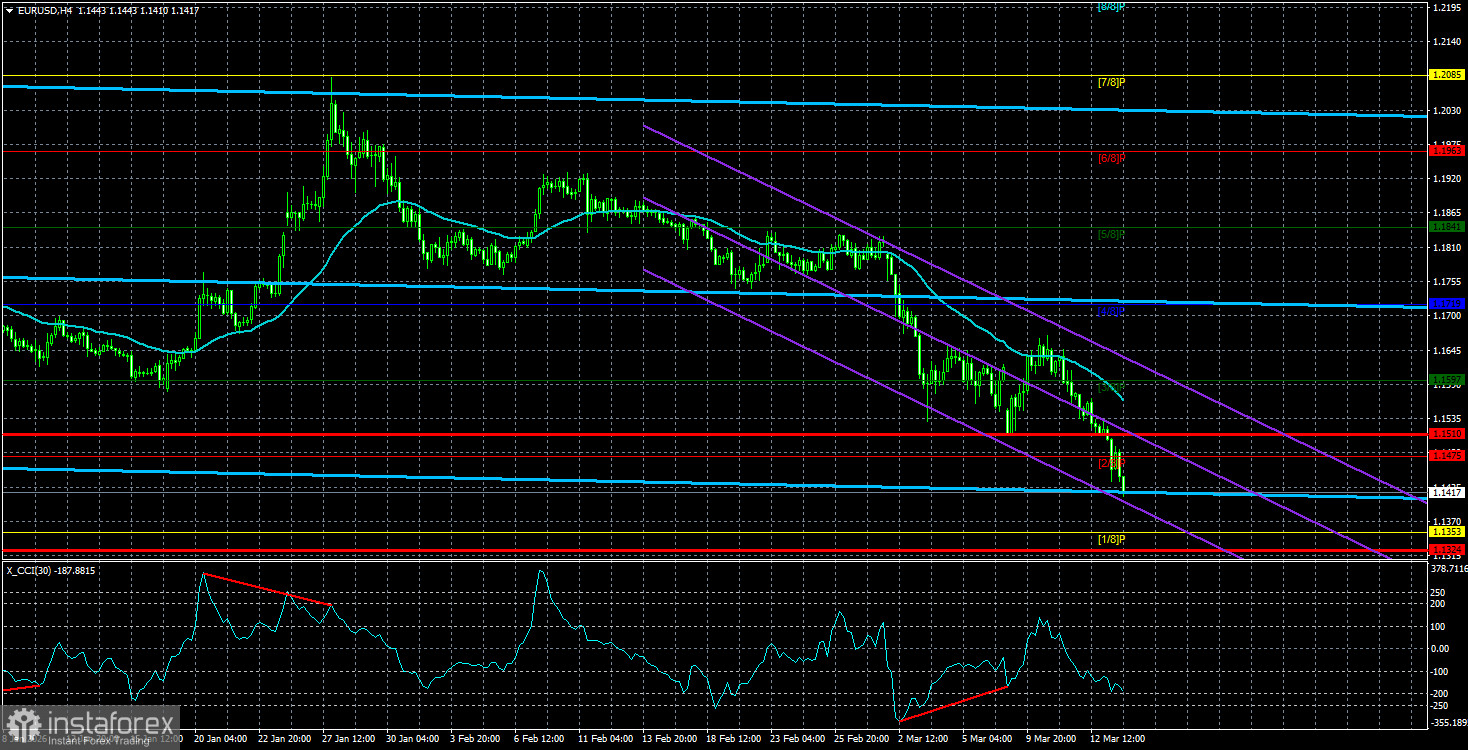
The EUR/USD currency pair moved exclusively downward on Friday and throughout much of the current week. At this point, it likely makes little sense to reiterate that the sole reason for the US dollar's rise is geopolitics. Recall that a week or two ago, we drew traders' attention to the fact that the market simply ignores dismal US macroeconomic data. Reports on Non-Farm Payrolls, unemployment levels, and GDP (in two estimates) had no pressure on the dollar. Thus, it can be confidently said that the market has been under the influence of geopolitics for about a month now. Initially, traders were preparing for a likely war between the US and Iran, but at that time, few understood the scale of the conflict and its global implications that would emerge in the first days. Then the market realized the problems the world would face if this war continued and began to factor in geopolitics with renewed vigor.
Naturally, most traders either believe or at least wish to predict any movement. However, in our opinion, this is impossible. Who could have guessed a few weeks ago that the conflict would reach such proportions? Who could have foreseen that the Hormuz Strait would be blocked not for a few days, but potentially for many months (let's recall that Iran had previously threatened to close the Hormuz Strait several times, but last summer, for instance, it merely resulted in a few retaliatory strikes)? Certainly, such assumptions were voiced, which could have led to speculation about the rise of the dollar. But there is a vast difference between speculation and possessing actual information.
Thus, the current rise of the dollar was nearly impossible to predict. Remember that almost all fundamental and macroeconomic factors are against the US currency, but as it turned out, the geopolitical factor is so strong that all others are rendered insignificant. Therefore, we consider it impractical to discuss the fundamental and macroeconomic backdrop for the new week. Just last Friday, the market ignored a new series of disappointing data from the US. It became known that US GDP in the fourth quarter slowed to 0.7% q/q, not 1.4% q/q. However, the dollar continued to rise, almost like on yeast. Durable goods orders were also frankly disappointing, but even this report went unnoticed by the market.
How much longer traders will rely solely on geopolitics in their trading decisions is also impossible to predict, as no one in the world knows how much longer the conflict will last, how high oil and gas prices will soar, how much more oil and gas infrastructure will be damaged or destroyed in the region, or which other countries will be affected by hostilities. Unfortunately, traders are left with little choice but to monitor developments, keep in mind that the likelihood of a dollar rise remains high, and strive to react to any news as quickly as possible.
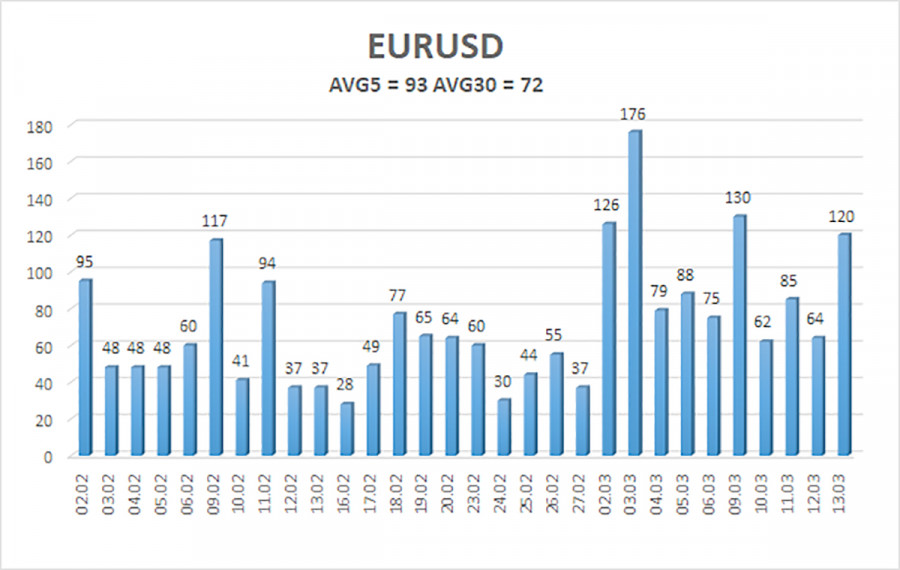
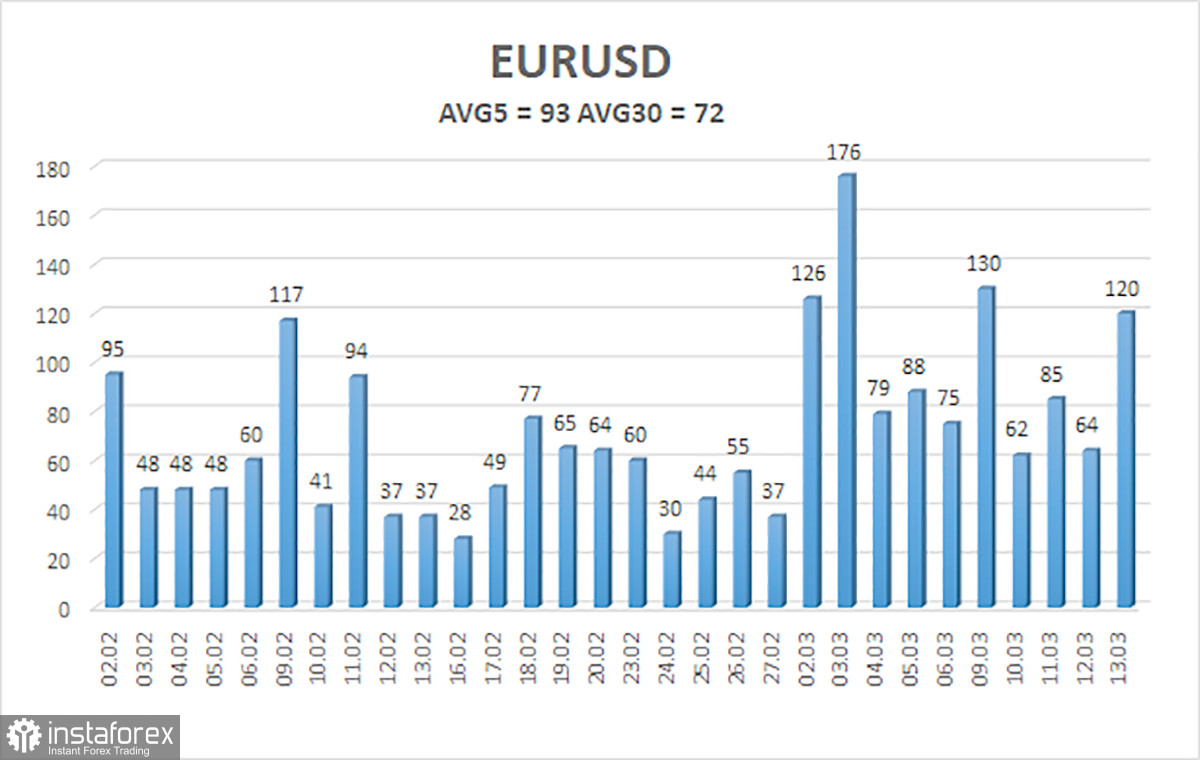
The average volatility of the EUR/USD currency pair over the last 5 trading days as of March 16 is 93 pips, which is "average." We expect the pair to move between levels 1.1324 and 1.1510 on Monday. The upper channel of the linear regression has turned sideways, indicating a potential trend reversal. The CCI indicator has once again entered the oversold zone and has formed a "bullish" divergence, but even technical signals are currently of no significance.
Nearest support levels:
S1 – 1.1353
S2 – 1.1230
S3 – 1.1108
Nearest resistance levels:
R1 – 1.1475
R2 – 1.1597
R3 – 1.1719
Trading Recommendations:
The EUR/USD pair continues its decline, which no longer resembles a correction. The global fundamental backdrop remains extremely negative for the dollar. However, for several weeks now, the market has focused solely on geopolitics, making all other factors irrelevant. With the price situated below the moving average, short positions can be considered with targets at 1.1353 and 1.1324. Above the moving average line, long positions remain relevant with targets at 1.1963 and 1.2085, but for this scenario to work, the geopolitical background must begin to stabilize.
Explanations for Illustrations:
Linear regression channels help identify the current trend. If both are pointing in the same direction, the trend is currently strong;
The moving average line (settings 20,0, smoothed) defines the short-term trend and the direction in which trading should currently proceed;
Murray levels are target levels for movements and corrections;
Volatility levels (red lines) indicate the likely price channel in which the pair will operate over the next 24 hours based on current volatility indicators;
The CCI indicator – its entry into the oversold area (below -250) or the overbought area (above +250) indicates that a trend reversal in the opposite direction is approaching.